
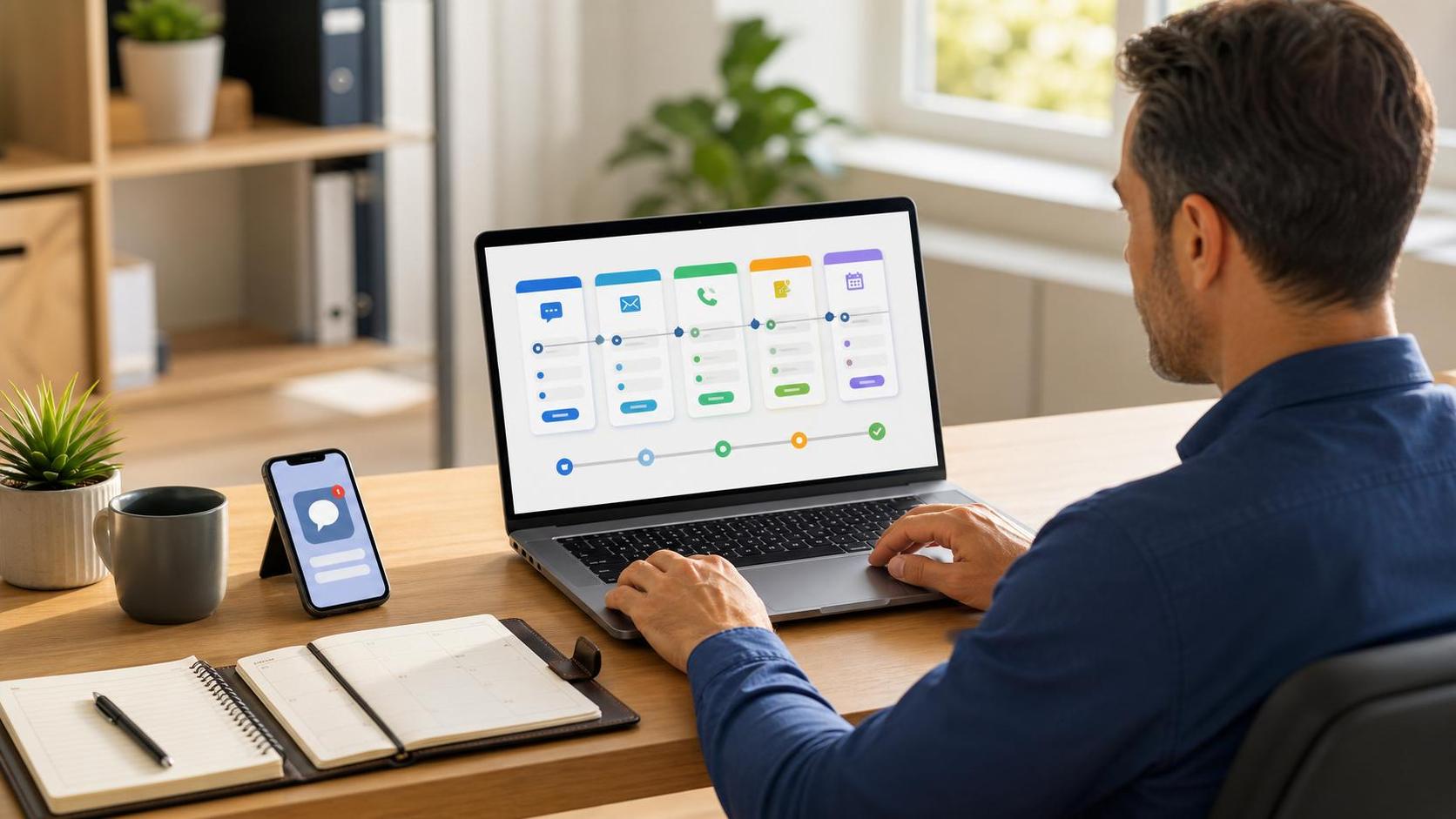
Most lost leads do not say “no.” They simply stop hearing from the business, get busy, choose a competitor, or forget why they reached out in the first place. For many small and medium businesses, the biggest revenue leak is not lead generation. It is inconsistent follow-up after someone has already shown interest.
Manual lead follow-up often depends on memory, staff availability, inbox discipline, or disconnected tools. That works when volume is low and everyone is available. It breaks when inquiries come in after hours, calls are missed, forms sit in an email inbox, or a busy team forgets to follow up a second or third time.
An automated lead follow-up sequence gives your business a simple, repeatable way to respond quickly, stay visible, and create clear next steps without adding unnecessary complexity.
Introduction
An automated lead follow-up sequence is a planned series of responses that starts when someone takes an action, such as filling out a form, calling your business, requesting a quote, booking an appointment, missing a call, or going quiet.
The goal is not to replace human sales conversations. The goal is to make sure every lead receives a timely, helpful response and that your team knows what should happen next.
A good follow-up sequence answers three questions:
- What should happen immediately after a lead comes in?
- What happens if the lead does not respond?
- Who or what is responsible for the next step?
When those questions are answered clearly, your business becomes easier to buy from.
The Problem
Many businesses spend time and money generating leads, but then lose potential revenue because follow-up is slow, inconsistent, or too limited.
Common revenue leaks include:
- A website form that only sends an email notification to one person
- A missed call that never receives a text-back or callback
- A lead that gets one reply but no second attempt
- An appointment request that is not confirmed quickly
- A prospect who goes quiet and is never re-engaged
These gaps are often invisible because the lead simply disappears. There is no obvious complaint, refund, or failed transaction. But over time, missed follow-up can quietly reduce revenue, weaken marketing ROI, and make the business feel less responsive than competitors.
Why This Happens
Lead follow-up usually breaks down for practical reasons, not because the business does not care.
Small and medium businesses often have staff handling multiple roles. A person answering phones may also be serving customers, managing scheduling, preparing quotes, or handling operations. When lead response depends entirely on manual attention, delays are almost guaranteed.
Follow-up also fails when systems are disconnected. A form may go to email, phone calls may live in a phone system, messages may come through social platforms, and appointment requests may sit in a calendar tool. Without a central CRM workflow or clear process, it becomes difficult to see which leads are new, contacted, booked, stalled, or lost.
This is where the broader lead response system matters. For a foundation on how lead response connects to revenue leakage, see LR-0001.
Business Impact
A lead follow-up sequence improves the parts of conversion that your business can control: speed, consistency, clarity, and persistence.
Fast response matters because interest is highest when the lead first reaches out. Repeated follow-up matters because many prospects are busy, distracted, or comparing options. Clear next steps matter because a confused prospect is less likely to book, reply, or buy.
The commercial impact often shows up in areas such as:
- Higher contact rates from new inquiries
- More appointments booked from existing leads
- Fewer prospects going cold after the first touch
- Better visibility into staff follow-up activity
- More revenue recovered from leads already generated
This does not mean automation guarantees sales. Lead quality, offer strength, pricing, timing, and customer fit still matter. But a reliable follow-up process reduces preventable loss.
Customer Psychology
Most prospects are not waiting around for your business to respond. They are busy, distracted, and often contacting multiple providers.
When they inquire, they are usually asking themselves:
- “Can this business help me?”
- “Will they respond quickly?”
- “What happens next?”
- “Do I trust them enough to move forward?”
A strong follow-up sequence lowers friction. It confirms the inquiry was received, gives the prospect a clear next step, and makes it easy to continue the conversation.
The best messages are short, helpful, specific, and action-oriented. Avoid vague “just checking in” messages. Instead, remind the prospect why you are contacting them and make the next step obvious.
For example: “Thanks for reaching out about your quote request. We can help with that. Would you prefer a quick call today or tomorrow to go over the details?”
Real World Example
Imagine a local service business that receives leads from its website, phone calls, and paid ads. Before automation, the process looks like this:
A prospect fills out a form. The form sends an email to the office. If someone sees it quickly, they call back. If the office is busy, the email waits. If the prospect does not answer the first call, the staff member may or may not remember to try again.
A simple automated sequence could improve this without becoming complicated:
- The form submission creates a new lead in the CRM.
- The lead receives an immediate confirmation by SMS or email.
- The team gets a task to call the lead as soon as possible.
- If there is no response, the system sends a same-day follow-up.
- The next day, the system sends another helpful message with a booking link or callback option.
- If the lead books, appointment reminders are triggered.
- If the lead does not respond, the CRM marks them for later re-engagement.
The business has not changed its offer. It has simply made the response process more reliable.
Common Mistakes
The most common mistake is assuming one follow-up attempt is enough. Many legitimate prospects will not answer the first call or reply to the first message.
Other common mistakes include:
- Over-automating and making every message feel generic
- Sending SMS or email without proper consent where required
- Failing to update CRM lead statuses
- Not assigning ownership for manual follow-up
- Ignoring lead source quality and treating every inquiry the same
Automation should improve the customer experience, not overwhelm people. If messages feel repetitive, unclear, or impersonal, the sequence may hurt trust instead of building it.
Solutions
Better processes
Before choosing tools, map the follow-up process. A simple planning framework is enough.
| Planning Item | Question to Answer |
|---|---|
| Lead source | Where did the inquiry come from? |
| Trigger event | What action starts the sequence? |
| Channel | Should the response use phone, SMS, email, chat, or a task? |
| Timing | When should the next touch happen? |
| Success metric | What shows that this step worked? |
Start with one lead source and one conversion goal. For example, focus first on website form fills with the goal of booking a consultation.
A simple starter sequence might include:
- Immediate confirmation after inquiry
- Fast SMS or call attempt
- Same-day follow-up if no response
- Next-day follow-up
- Two or three additional value-based touches over several days
- Appointment reminders if booked
- Re-engagement after a defined quiet period
Better systems
A CRM workflow makes the process visible and repeatable. It helps your team understand where each lead stands and what should happen next.
Useful CRM stages might include:
- New lead
- Contact attempted
- Responded
- Appointment booked
- No response
- Stale or re-engagement needed
CRM tasks are especially useful when a human action is still required. For example, the system can remind a staff member to call a high-intent lead, review a quote request, or follow up after a missed appointment.
The point is not to build a complex pipeline. The point is to prevent leads from being forgotten.
Automation
Automation makes the sequence reliable by triggering actions based on lead behavior.
Common triggers include:
- New form submission
- Missed call
- Quote request
- Appointment booked
- Appointment canceled
- No response after a set time
- Stale opportunity in the CRM
Channel choice matters. SMS is useful for speed and visibility. Email is useful for detail, documentation, and longer explanations. Phone calls are valuable for high-intent or complex inquiries. Voicemail, chat, and CRM tasks can support the process when used intentionally.
Automated messages should be concise and focused on the next step. Each message should answer: “Why am I receiving this, and what should I do next?”
AI
AI can support lead follow-up when used carefully. It can help qualify leads, answer common questions, route inquiries, summarize conversations, send reminders, and prompt staff when a human should step in.
For example, an AI-assisted workflow could ask a new lead a few basic questions, confirm their needs, and then route them to the right staff member or booking calendar. It could also summarize the conversation inside the CRM so the team has context before calling.
AI should not make the experience feel cold or confusing. Use it to improve responsiveness and consistency, not to hide the business from the customer.
AI Opportunity
AI employees or AI-assisted workflows are most useful when they remove bottlenecks. They can help your business respond after hours, handle repetitive questions, and keep leads moving until a person is needed.
Good uses of AI in lead follow-up include:
- Asking basic qualification questions
- Suggesting the next best follow-up action
- Summarizing lead conversations for staff
- Sending reminders based on CRM status
- Escalating urgent or high-value leads to a human
Keep the human handoff clear. If a prospect wants pricing, scheduling help, or a detailed recommendation, AI should support the transition rather than trap the person in a loop.
Quick Wins
If you want to improve lead follow-up quickly, start with the highest-leak points.
Three practical quick wins:
- Automate instant responses to website form fills Confirm the inquiry was received and explain what happens next.
- Add missed call text-back If someone calls and you miss it, send a prompt message offering a callback or booking option.
- Create CRM tasks for no-response leads Do not rely on memory. Assign the next action automatically.
These small improvements can help stop leads from going cold while you build a more complete system.
Book a Free Revenue Recovery Consultation
Frequently Asked Questions
What is a lead follow-up sequence?
A lead follow-up sequence is a planned series of messages, calls, reminders, and tasks used after someone contacts your business. It helps ensure each lead receives timely communication and a clear next step.
How quickly should my business respond to a new lead?
As quickly as possible. Immediate acknowledgement is ideal, followed by a fast human or AI-assisted contact attempt. Speed-to-lead is often one of the most important controllable factors in lead conversion.
Should I use SMS or email for lead follow-up?
Use both when appropriate. SMS is good for quick visibility and short prompts. Email is better for details, confirmations, links, and documentation. Make sure you follow applicable consent rules for automated messaging.
How many times should I follow up with a lead?
One attempt is usually not enough. A practical small business sequence often includes an immediate response, same-day follow-up, next-day follow-up, and two or three additional helpful touches over several days.
Can AI replace my sales follow-up?
AI should support your sales follow-up, not fully replace it. It can answer common questions, qualify leads, send reminders, and alert staff. Human follow-up is still important for trust, judgment, and complex conversations.
What should I measure to know if follow-up is working?
Track speed-to-lead, contact rate, response rate, appointment booking rate, show rate, conversion rate, number of follow-up attempts, stale lead volume, and revenue recovered from re-engaged leads.
Key Takeaways
- Many leads are lost because follow-up is slow, inconsistent, or stops too soon.
- A simple automated sequence can improve response speed and reduce forgotten leads.
- Start by mapping lead source, trigger, channel, timing, owner, and success metric.
- Use CRM workflows to make the process visible and assign next actions.
- SMS, email, phone, and CRM tasks each serve different roles.
- AI can help with qualification, routing, reminders, and summaries, but should not make the experience impersonal.
- Keep the system simple at first, then expand after measuring results.
Next Steps
Review your current lead response process from the moment a prospect first contacts you. Look for the top three places leads fall through the cracks.
Start with these questions:
- Which lead source creates the most missed or delayed follow-up?
- What happens when a lead does not answer the first call?
- Are leads tracked clearly inside the CRM?
- Who owns the next action at each stage?
- What metric will show improvement?
For the broader foundation on lead response and revenue leakage, use LR-0001 as the starting point, then build this follow-up sequence around your most important lead sources.
- Lead Response: Why Speed-to-Lead Matters
- Missed Call Text Back: The Fastest Way to Recover Lost Leads
- Automated Follow-Up: How Leads Stop Falling Through the Cracks
Book a Free Revenue Recovery Consultation
If you want help identifying where revenue is leaking from your business, book a free consultation.